Meet the researchers: Andreia Teixeira
Each week, we introduce one of the early-career researchers behind the WildPosh project. Meet the young scientists working to understand and protect wild pollinators across Europe.
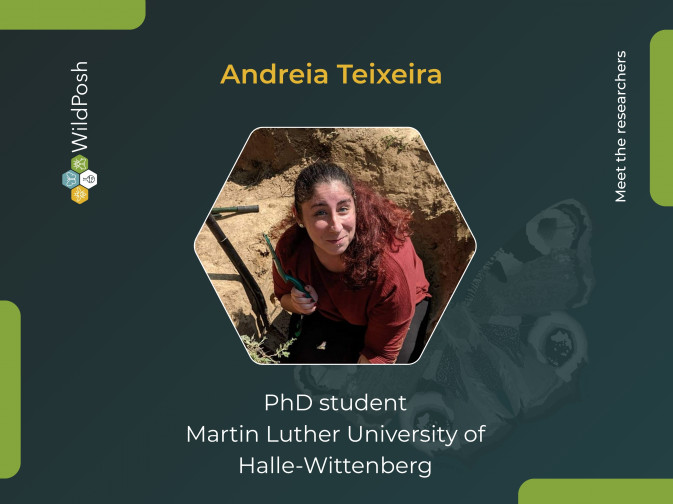
Andreia Teixeira is a PhD student in the Department of Zoology of Martin Luther University of Halle-Wittenberg.
Question: What drew you to working with wild pollinators?
Andreia Teixeira: It was during my master's degree that I fell in love with social insects and their incredible diversity. I worked with ants for some time and briefly explored their role as pollinators, but I must say that there is something special about bees - besides the challenge they present when working with them in the lab compared to other species (one can probably blame the wings for that). Bees have such an interesting evolutionary history, from predators to vegetarians, solitary to social, egg-laying structures to stings, and even stingless... There are infinite questions to be answered! Besides that their absolutely fundamental role as pollinators lets us build a solid bridge between fundamental and applied research, and that's one of the things keeping me hooked.
Q: What's the most exciting part of your work in WildPosh?
AT: I think the most exciting part of my work is to realise that what I'm doing in the laboratory can have a real impact not only in pollinators health but also in quality of data collection, risk assessment protocols design and European regulations for the use of pesticides. What makes it even better is the opportunity to collaborate with such a diverse group of researchers, all driving toward a common goal.
Q: What's one finding or moment from your research that stood out to you?
AT: The moments that definitely stood out to me during all my research were every time I realised how strong and determined these tiny creatures can be, particularly when working with the mason bee Osmia bicornis. I lost count of how many times these bees chewed their way out of the containers used for the experiments and were just happily flying around in the laboratory.
Q: How do you hope your work in WildPosh will help protect pollinators in Europe?
AT: As I mentioned above, I hope our laboratory results on wild pollinator sensitivity to pesticides will influence European regulations in the near future. Beyond regulation, I also hope our efforts can have a direct impact, not only informing governmental agencies, farmers, and the public about the importance of better practices, but also fostering broader interest in protecting wild pollinators and biodiversity.
Q: What's something about pollinators you wish everyone knew?
AT: Butterflies, hoverflies, wasps and bats are very good pollinators too! We should take good care of those as well. And if I can be biased for a second... There's more than 20 000 bee species in our planet. Did you know that most of them are solitary? Ah, some bee species can eat meat and wasps can produce honey as well. Hope this is enough to make you more curious!
Curious about the evolutionary history of bees? Check out a new documentary featuring WildPosh.