Meet the researchers: Cristina Parenti
Each week, we introduce one of the early-career researchers behind the WildPosh project. Meet the young scientists working to understand and protect wild pollinators across Europe.
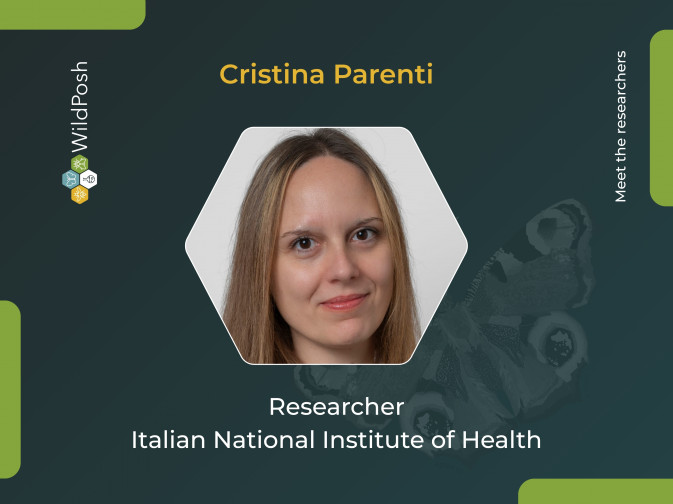
Cristina Parenti joined the Istituto Superiore di Sanità, Department of Health and Environment, about a year ago. She has over 15 years of experience as an engineer, and her professional background spans mechanical engineering research and applied engineering work. Her academic research focused on in-vitro testing using nanoindentation to evaluate the mechanical properties of biological tissues such as the heart, aorta, and brain, followed by extensive work on building energy modelling, HVAC design, and life cycle assessment.
For Cristina, WildPosh is a new and exciting chapter. Her current activities include developing Python-based models and carrying out statistical analyses in the toxicological sector, combining her engineering expertise with data-driven approaches.
Question: What drew you to working with wild pollinators?
Cristina Parenti: Sometimes it’s people who shape our paths the most. My journey into wild pollinator research began when I met my current scientific lead, Olga Tcheremenskaia, while we were guiding a group of Engineering students during their thesis work on designing a data-driven platform. What started as a professional interaction soon grew into a collaboration grounded in shared ideas, trust, and friendship, eventually leading me to WildPosh. Environmental protection has always guided my professional decisions, but that encounter acted as a catalyst, transforming a long‑held commitment into a focused mission centred on pollinators and their protection.
Q: What's the most exciting part of your work in WildPosh?
CP: One of the most exciting aspects of my work in WildPosh is discovering how many different chemical substances wild pollinators can be exposed to, where these substances come from, and how they are regulated. Looking into compounds such as neonicotinoids, fungicides, or herbicides, and understanding how they are authorised, restricted, or banned across different countries, really highlights how complex environmental exposure can be and how closely chemical regulation is linked to ecosystem health. On a lighter note, there is also a more visual side to the project, mostly aimed at communication and social media rather than fieldwork. Trying to take clear, close-up photos or videos of wild bees feeding on lavender plants is surprisingly challenging, and it quickly shows that even capturing simple moments from the life of wild pollinators takes patience, timing, and a bit of luck.
Q: What's one finding or moment from your research that stood out to you?
CP: One finding that really stood out to me is realising how much physiological stress wild pollinators can experience even when they survive chemical exposure. Research within WildPosh shows that exposure to certain pesticides does not always cause immediate mortality, but it can significantly affect bees’ energy use and internal physiological balance. Pollinators may need to spend more energy on detoxification and stress responses, leaving less energy available for essential activities such as foraging, navigation, reproduction, or coping with other environmental pressures. This was a powerful reminder that survival alone is not enough to define pollinator health, and that these hidden costs can have serious long-term consequences for individuals and populations.
Q: How do you hope your work in WildPosh will help protect pollinators in Europe?
CP: I hope our work in WildPosh can provide clear, solid information to help stakeholders make wiser decisions when it comes to using pesticides. Better knowledge means better choices, for both pollinators and the environment. And honestly, if Europe does not start setting a good example of how chemicals should be assessed and used responsibly, then who will?
Q: What's something about pollinators you wish everyone knew?
CP: I wish more people knew that pollinators are not just bees. Some of the most unexpected pollinators mentioned in scientific literature include hoverflies, which can be just as effective as bees for certain plants; beetles, among the earliest pollinators in evolutionary history, and moths, which quietly do much of their work at night. Butterflies, flies, and even some wasps also play a role. One of the challenges, also reflected in WildPosh, is that we still lack enough data on many of these non‑bee pollinators.