Meet the researchers: Jordan Benrezkallah
Each week, we introduce one of the early-career researchers behind the WildPosh project. Meet the young scientists working to understand and protect wild pollinators across Europe.
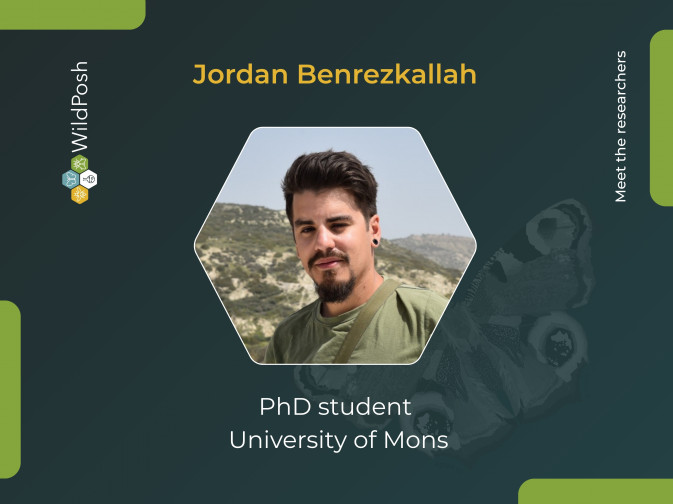
Jordan Benrezkallah has been working at the University of Mons (Belgium) in the Zoology Laboratory since 2022, first as a research assistant and then as a PhD student from 2023. His work focuses on biodiversity data management, particularly the standardisation, integration, and validation of pollinator occurrence records to ensure they can be reliably used by the wider scientific community.
Question: What drew you to working with wild pollinators?
Jordan Benrezkallah: Growing up, I was fascinated by animals, but as I got older, I realised that vertebrates, despite their fame, represent only a tiny fraction of life's diversity. The world of insects felt far more mysterious, especially pollinators; we see them every day on flowers, yet we know so little about them. That gap is what drew me in.
Q: What's the most exciting part of your work in WildPosh?
JB: My favourite part of my work is creating data visualisations. Behind that lies a lot of less glamorous work: collecting, cleaning and validating data from a large number of contributors, all through coding. But what I love is the creative challenge of taking millions of data points, representing real insects observed across Europe and distilling them into a single, clear figure. When that works, it can reveal patterns about pollinators in a way that anyone can understand. That moment when the data tells a story is what I find most exciting.
Q: What's one finding or moment from your research that stood out to you?
JB: One moment that stood out was the chance to study Megachile cypricola, a wild bee found only on the island of Cyprus and classified as critically endangered. Very little data existed on this species, so being able to assess its population status, diet and photograph its nest-building behaviour over several days, it was a very emotional experience.
Q: How do you hope your work in WildPosh will help protect pollinators in Europe?
JB: My work focuses on making as much validated data as possible openly available, with full documentation, so the scientific community can build on it. I hope that by identifying which pollinator populations are most vulnerable to pesticides, this work will ultimately inform better policy decisions, ones that don't just slow biodiversity loss, but actively help restore it.
Q: What's something about pollinators you wish everyone knew?
JB: Most people think of a honeybee when they hear the word 'pollinator', but there are thousands of wild bee species alone, each with their own appearance, behaviour and ecological role. Beyond bees, countless butterflies, hoverflies, beetles and moths contribute to pollination. And without them, much of the food on our plates simply wouldn't exist. I wish more people understood just how deeply our societies depend on these creatures and how cool they are.
Explore WildPosh study species.