Meet the researchers: Margret Jürison
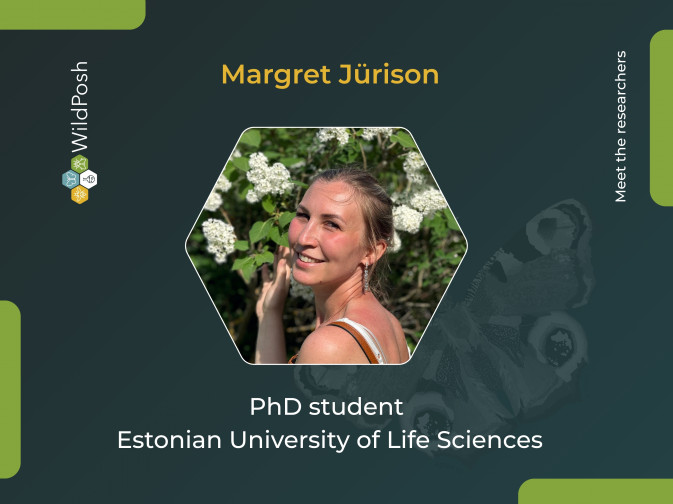
Each week, we introduce one of the early-career researchers behind the WildPosh project. Meet the young scientists working to understand and protect wild pollinators across Europe.
Margret Jürison is a PhD student and junior researcher at the Estonian University of Life Sciences (EMÜ).
Question: What drew you to working with wild pollinators?
Margret Jürison: I’ve always been interested in insects, and both my Bachelor’s and Master’s studies focused on Diptera, though not specifically as pollinators. I actually got into pollinators through my partner, who took over beekeeping from his grandmother. That experience sparked my interest in pollinators more broadly, and when I decided to pursue a PhD, I knew I wanted to focus on this topic to better understand these insects in more depth.
Q: What's the most exciting part of your work in WildPosh?
MJ: The best part is definitely fieldwork - being out in nature, learning new methods, and seeing a wide range of species. It’s always exciting to recognise familiar ones and at the same time come across species that are completely new to you.
Q: What's one finding or moment from your research that stood out to you?
MJ: One of the most exciting moments during the WildPosh fieldwork was collecting pollen with a vacuum. It’s not something you’d normally expect, so it was both fun and really interesting to try in practice.
Q: How do you hope your work in WildPosh will help protect pollinators in Europe?
MJ: I hope our work will help us better understand whether and how pesticides actually reach pollinators. Based on this knowledge, we can make more informed decisions about agricultural practices and develop measures that better protect pollinators in the field.
Q: What's something about pollinators you wish everyone knew?
MJ: I wish more people knew that pollinators are not just bees - there are many species like flies, butterflies, and beetles that play important roles. Also, even small actions, like planting diverse native flowers, can have a big impact on supporting them.
Researchers from EMÜ, Margret's institution, recently presented WildPosh on Estonian national TV.