Meet the researchers: Milica Radenković
Each week, we introduce one of the early-career researchers behind the WildPosh project. Meet the young scientists working to understand and protect wild pollinators across Europe.
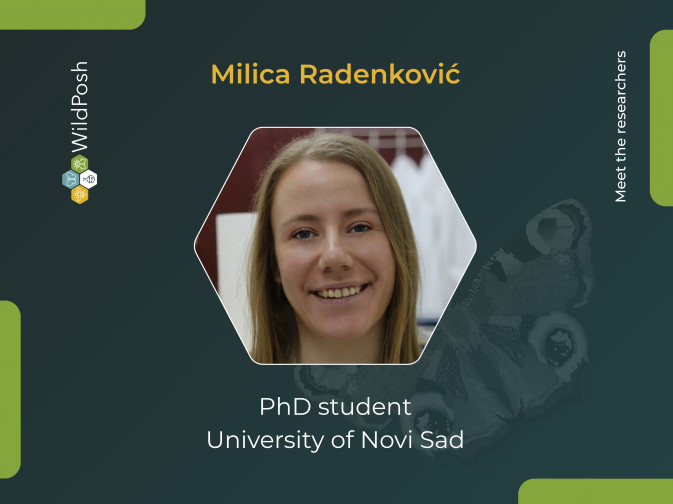
Milica Radenković has been working at the Faculty of Sciences at the University of Novi Sad for a little over two years. She is currently a PhD student, and the research she does within this project will be part of her PhD dissertation. Her team studies the effects of pesticides on hoverflies through acute contact and oral tests. In addition to monitoring survival and sublethal effects, they also perform molecular and biochemical analyses to better understand the effects of pesticides.
Question: What drew you to working with wild pollinators?
Milica Radenković: Since my undergraduate studies, working with insects has been very interesting to me. My professors played a significant role in developing this interest, especially when it comes to wild pollinators, while field research further strengthened my curiosity. I find insects to be fascinating organisms, with beautiful details that make them even more interesting to study. In addition, their importance in ecosystems and agriculture is immeasurable. The WildPosh project has allowed me to work with this group of animals that I have always been interested in, while also allowing my work to have a broader, practical impact.
Q: What's the most exciting part of your work in WildPosh?
MR: Since we work with hoverflies, a group that is often overlooked in research and therefore still lacks sufficient data, this aspect itself represents a special challenge and motivation. The difficulties we faced, especially at the very beginning, during the first experimental setups, getting familiar with the species, and adapting to laboratory work, made the whole process both demanding and very engaging.
What I would especially highlight is the feeling that I am doing something truly beneficial for pollinators. The awareness that our work can make a real contribution to their conservation, along with the hope that our results will help protect their populations, is a strong motivation for further work.
Q: What's one finding or moment from your research that stood out to you?
MR: The results on the sensitivity of hoverflies to pesticides are very important in themselves. In addition to the mortality caused by pesticides, I would especially highlight the sublethal effects, that is, everything individuals go through after pesticide exposure. These effects are what surprise me every time, unfortunately, not in a positive way.
Through them, we become increasingly aware of how much our activities can affect small but extremely important organisms, both for nature and for ourselves.
Q: How do you hope your work in WildPosh will help protect pollinators in Europe?
MR: I believe that WildPosh is an important project for the conservation of wild pollinators, as it includes all major groups of pollinators in Europe. I hope that our research will highlight the sensitivity of hoverflies and encourage further studies focused specifically on them. I also believe that the results will help include these species in official toxicological testing, thereby further emphasising their importance and improving measures for their protection and conservation.
Q: What's something about pollinators you wish everyone knew?
MR: I would like people to become more aware of how many different species of wild pollinators actually exist, as well as the diversity and range of services they provide. It is important not to focus only on a small number of well-known species, but to emphasise the importance of a much broader spectrum of pollinators, which together play a key role in ecosystem functioning.
And one small additional thought is that if you take enough time to observe insects, you realise how many beautiful and fascinating details exist in their morphology, biology, and ecology. You become more aware that they are actually an extremely interesting and beautiful group of organisms, rather than something to be afraid of.
Learn more about an oral toxicology test for hoverflies developed within WildPosh.