New open dataset brings together traits of 3,000 European wild bee and hoverfly species
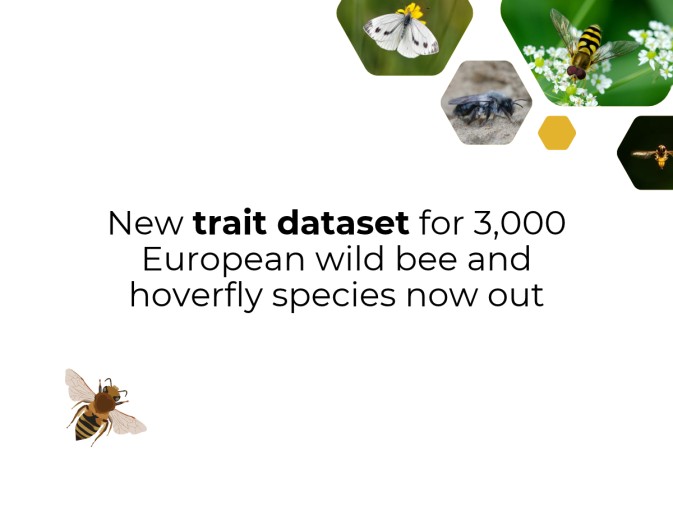
Wild bees and hoverflies are among Europe's most important pollinators, and many of their populations are declining. Monitoring each of the continent's thousands of species one by one would be very hard. A new paper in Scientific Data offers a practical alternative: the first continent-wide trait dataset covering both groups, compiled by more than 40 experts, including WildPosh partners.
The dataset covers 3,052 European species: 2,139 bees and 913 hoverflies. Until now, information on how these insects live was scattered across scientific papers and national databases, or existed only as experts' knowledge. Existing collections were also limited to certain countries or to only one of the two groups. That made it hard to compare species or to analyse many groups at once.
The new resource lists 18 traits shared by both groups, plus 13 traits specific to bees and eight specific to hoverflies. These cover the whole life cycle of the insects, grouped into five areas:
- Nesting: where and how species build nests, and what materials they use
- Larvae: where larvae live, what they eat and how long they take to develop
- Adult body features: such as body size, hairiness and tongue length
- Behaviour and ecology: such as social life, number of generations per year, and tolerance to human influence
- Distribution: flight season, habitat, range size and climate preferences
Traits like these show what a pollinator does and how sensitive it is, not just its species. That makes it possible to monitor pollinators by functional group, for example by tracking how ground-nesting bees, or hoverflies whose larvae need wetlands, respond to climate change, land use or pesticides. This approach is cheaper and can reveal more about why pollinators are declining.
Expert taxonomists checked the data in workshops, corrected errors and filled gaps using their own collections and field experience. The dataset is freely available on Zenodo, together with a version formatted for GBIF, the global biodiversity data network, so it can be plugged into biodiversity databases. The authors invite users to report errors or additions so the dataset can keep improving.
The dataset gives researchers and policymakers a shared foundation for studying the role of these pollinators, designing targeted conservation measures and supporting EU goals under the Pollinators Initiative and the Biodiversity Strategy for 2030.
Read the full article.