Meet the researchers: Kaarel Pent
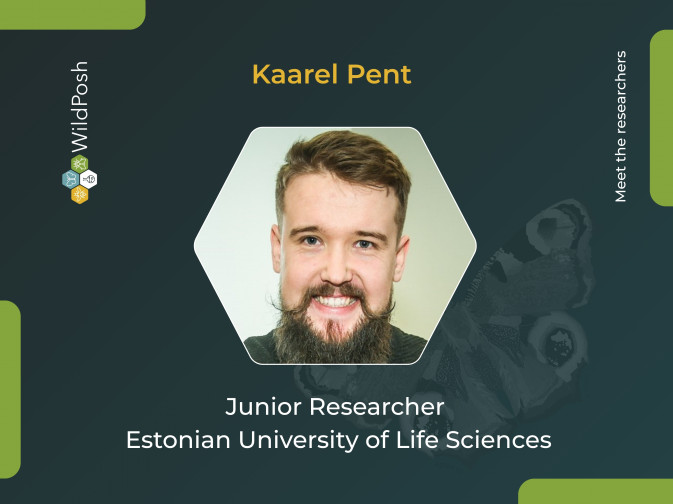
Each week, we introduce one of the early-career researchers behind the WildPosh project. Meet the young scientists working to understand and protect wild pollinators across Europe.
Kaarel Pent is a junior research fellow in agricultural sciences at the Estonian University of Life Sciences.
Question: What drew you to working with wild pollinators?
Kaarel Pent: I have long been interested in pollinators because of their essential role in both natural ecosystems and agriculture. What especially drew me to this field was the opportunity to better understand how different stress factors affect their health and survival, and how this knowledge can help us protect them more effectively. In addition, there are increasing EU policy and regulatory expectations to preserve landscape elements that support pollinators and other beneficial insects, and I am particularly interested in understanding whether these measures are truly effective and necessary, especially in the Estonian context.
Q: What's the most exciting part of your work in WildPosh?
KP: The most exciting part for me is being able to contribute to research that has both scientific value and practical importance. I find it especially rewarding to study pollinator biology and stress responses in a way that can support better protection measures and more pollinator-friendly agricultural practices.
Q: What's one finding or moment from your research that stood out to you?
KP: One of the most striking aspects of my research has been seeing how sensitive pollinators can be to different environmental and physiological stressors. It has been very meaningful to observe that even relatively small changes in conditions can have clear effects on pollinator wellbeing. This highlights how important careful research and monitoring really are.
Q: How do you hope your work in WildPosh will help protect pollinators in Europe?
KP: I hope my work will contribute to a better understanding of the pressures pollinators face and help support evidence-based decisions in both agriculture and environmental management. In the long term, I would like this research to help create conditions in which pollinators can thrive alongside productive farming systems.
Q: What's something about pollinators you wish everyone knew?
KP: I wish more people understood that pollinators are not only important for crop production, but also for maintaining biodiversity and healthy ecosystems. Protecting pollinators is therefore not only about saving individual species, but also about supporting the resilience of the environments we all depend on.
We also interviewed another early-career researcher from Kaarel's institution, the Estonian University of Life Sciences. Read the interview with Margret Jürison.